Photography © Debby Besford

Contemporary and Country (C&C) present contemporary and applied art by artists and makers from East Anglia.
C&C's pop-up exhibitions frequently forego the art gallery setting, opting for architecturally interesting spaces that encourage visitors to engage with art.
The Viewing Room
To better support East Anglian creatives C&C have opened a viewing room where we hold small-scale solo or two person exhibitions, showing new work.
The viewing room is open from Wednesday to Friday 11am to 4pm and Saturday from 11am to 2pm, at Woolmarket House, 6 St Nicholas Street, King's Lynn, Norfolk PE30 1LY.
Outside these hours entry can be arranged by appointment in advance. If you book ahead we will try to accommodate your preferred time. It is a viewing room and not a gallery, so we can only take groups of about six or seven people.
For many East Anglian artists and makers the landscape is frequently the source of their inspiration.
The artists and makers C&C work with live and work throughout the east of England. Others live elsewhere, in cities like London, and spend time here, maintaining their connection with their home town, or working with an aspect of the landscape that is particular to the east coast. Through their creative process, artists and makers celebrate their rural surroundings bringing about a closer understanding of the land, the coastal areas, and the way of life here.
C&C display original work in group and solo exhibitions that open up opportunities for artists and makers.
Creatives have access to more generous workshop and studio space in the east. The region's 'homegrown' talent has gathered in particular locations throughout East Anglia, and they have attracted others from more metropolitan centres.
While this upturn in creative activity by artists and makers among rural communities represents a welcome development, there are still relatively few spaces to show the results of their labour locally.
The dearth of suitable display space is one of several issues that concern creatives in rural locations. C&C address the scarcity by finding unusual buildings, both gallery and non-gallery settings to hold pop-up group and solo exhibitions.
These feature original work configured around themes or a shared methodology, that attract local audiences as well as visitors from London, Cambridge, Leicester and Nottingham. C&C's exhibition programme appeals to an informed, art savvy audience, driving attention toward contributing creatives, brokering sales and facilitating a greater understanding of the work on display.
The existing network of art galleries and museums and how they operate within the eastern region.
East Anglia's network of galleries and museums are a valuable resource for creatives, however their remits limit the scope of the art they are able to programme.
Public sector:
The east of England is fragmented by distance and has relatively few urban areas, with the exception of Norwich and Colchester. These locations have two important beacons for contemporary art: The Sainsbury Centre (UEA, Norwich) and First SIte (Colchester), as well as a handful of publicly funded galleries and museums that have had a limited or intermitent contemporary programmes.
As publicly funded organisations they have worked hard to maintain their profiles and encourage engagement with local audiences. Yet despite their relative success in addressing audience development and investing in visitor facilities their funding streams have been systematically reduced.
What little funding there is made available by government, has been made dependent upon also raising funds from the private sector. This model mitigates the ever decreasing investment in our cultural infrastructure, however it raises problems for the institutions. Implicit in the generous act of donation is the expectation that artists follow an agenda set by patrons and the tastes they express through their collecting activities. These often well-meaning individuals inevitably have their own idea of what they will and won't fund, thereby holding back the development of certain types of art they have no personal interest in.
Private sector:
Commercial galleries based particularly along the North Norfolk and Suffolk coasts embrace the tourist market, catering to what is a more transitory seasonal audience. Focussing on well-healed tourists makes commercial sense for them, but it does mean their exhibition programme is tailored to lower expectations - what is displayed seems pedestrian, and the season has become restricted to the summer months. There is little attempt in the private sector to give more innovative work the opportunity to find an audience. Which isn't of any use for creatives making more challenging work or discerning collectors who want to buy it.
The situation is nothing new. The shortcomings of public and private sector galleries have been well-documented. Both sectors have had to respond to the limitations of the art market outside of our major cities, which is one circumscribed by inadequate funding and limited visual arts provision.
Thankfully, the strategic restrictions introduced by successive governments demoting our creative output have had the unwitting effect of provoking motivated individuals to present contemporary and applied art in a variety of different ways. Artist run initiatives, and small organisations like C&C provide a kind of bedrock for creatives to help counter the prevailing anti-culture movement in the country at the moment.
C&C operate by moving around the region showing original work and encouraging engagement from new audiences.
C&C are not alone in trying different models to push back the mood of indifference and provide a more reliable platform for artists and makers to get their work seen. There are quite a few smaller organisations (too many to list here!), who have made a significant contribution toward redressing the balance in favor of more innovative creatives. We like to think C&C are probably among the more responsive organisations to the needs of artists and makers. As we have developed we have encouraged a broader audience of informed art collectors from larger cities, and an informal grouping of buyers and collectors based locally to where we hold our pop-ups, interested in supporting creative work. In doing so we have attracted new, younger collectors who want to live with original art and handmade objects that will last a lifetime, rather than buy mass-produced 'wall art'.
C&C raise audience expectations by moving around the region, showing high quality work produced here and displaying as best we can to its advantage, by not being teathered to a single location.
To enable better representation C&C's projects are tailored to the way artists and makers operate today, providing a curated context to show their work, connecting with a diverse audience through real life displays or online.
You may have already visited a C&C pop-up exhibition without realising it...
C&C's pop-up exhibitions have been held at Stapleford Granary, Cambridge, The Crypt Gallery, Norwich, The Fermoy Gallery and Shakespeare Barn at St. George's Guildhall, King's Lynn, Houghton Hall Stables, in West Norfolk, at BallroomArts, Aldeburgh, on the Suffolk coast, The Granary (Jarrolds), in Norwich, and at Creake Abbey near Burnham Market on the North Norfolk coast. For each of these installations the work was chosen to suit the circumstances of the built environment of each venue. Whether that was a purpose built beachside art gallery, the top floor loft-space in a converted warehouse store, or an ancient chalk and flint barn, visitors were attracted by the experience and then stayed for the art.
C&C's exhibitions at the Stables Houghton Hall took place between 2017 and 2023. These were large group exhibitions featuring between 30 to 45 artists and makers with an East Anglian connection that were predicated upon a common theme. They were configured to support the solo exhibitions by acclaimed international artists: Richard Long, Henry Moore, Damien Hirst, Anish Kapoor, Tony Cragg, Ernst Gamperl, John Virtue, and Sean Scully.
-
MEDIA COVERAGE
-

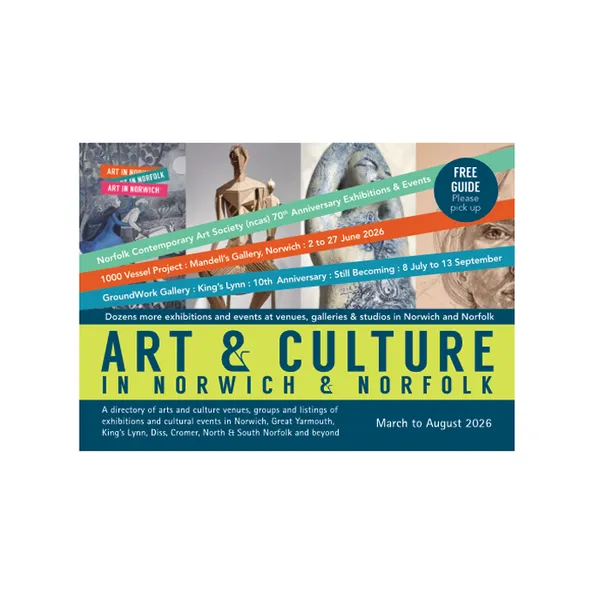
Art & Culture in Norwich and Norfolk
New guide to exhibitions across East Anglia 21 March 2026As the new spring season of art and cultural events starts the latest edition of Art in Norwich and Norfolk compiled and produced by Marion Caitlin. We are featured in... -
North Norfolk Living - Spring edition
Feature on our latest exhibition and those about to open 19 March 2026Big thank you to Amanda and her team at North Norfolk Living magazine for featuring us in their latest issue - Spring 2026.magazine. This is a great free resources to... -
Your Local Paper
New display at Lynn gallery opens today 4 March 2026Thank you to th editor and staff at Your Local Paper, based in Tuesday Market Place , King's Lynn for carrying a feature about the opening of our new exhibition.... -
North Norfolk Living
Autumn Edition 13 October 2025Thanks to Amanda Loose and her team at North Norfolk Living magazine (Autumn edition). Just out and coincides with the launch of our third - Viewing Roomin our new showcase... -
North Norfolk Living
High Summer Edition 9 July 2025Many thanks to Amanda Loose and her team at North Norfolk Living magazine (High Summer edition). Just out and coincides with teh launch of our new initiatve - Viewing Room.... -
North Norfolk Living
What's on, What's Good & Where to Go! 3 October 2024Our latest exhibition 'Lay of the Land: East Anglian Landscape Now' is featured in the new edition of North Norfolk Living. We are grateful; to editor, Amanda Loose and her... -
Life & Times in Norfolk October 2024
Celebrating a Unique East Anglian Landscape 20 September 2024Huge thanks to Emma Lee and her team at Norfolk Magazine for their feature in the 'Life & Times' section - p157 of the newly published October edition of Norfolk... -
KL Magazine - North Norfolk
Lay of the Land: The East Anglian Landscape Now 25 September 2024We are grateful to the KL Magazine team for this article that was published in the September edition of this popular local magazine. In it they encouraged readers to explore... -
Art & Culture in Norwich and Norfolk
New Exhibitions across the region 6 September 2024As the 2024 season of arts events comes to the end of 2024 we are delighted to be featured in the latest edition of Art in Norwich and Norfolk produced... -
Rosie Phillips - ArtRabbit
Portrait paintings and drawings following her residency at Norwich School, 10 January to 15 February,2024 10 February 2024Following her residency at Norwich School, Cathedral Close, Norwich, Contemporary and Country have curated 'Close' an exhibition of recent paintings at The Crypt Gallery. SEE ARTICLE -
Country Life - Heads & Tails makes it as an Unmissable Event
Unmissable Events 11 October 2023We are grateful to the editorial team at Country Life for giving us a mention in the 'Unmissable Events' section on p47 of this week's edition. -
Arty Facts in North Norfolk
Animal Magic 20 September 2023 -
Going Out - with a fair few animals included
7 September 2023Big thank you to the Places and Faces team for including mention in 'Going Out' column. Our new exhibition 'Heads & Tails: Picturing People and Other Animals' is open in... -
Heads & Tails - ArtRabbit
6 September 2023Norfolk Spotlight: Heads & Tails. Picturing People and Other Animals We are grateful to Vivi and her team at ArtRabbit for this feature on our new exhibition in the heart... -
ArtsEast: Heads and Tails at The Guildhall, King's Lynn
5 September 2023A huge thank you to Sarah Veness and her tteam aat ArtsEast for running an article about our current show 'Heads & Tails: picturing people and Other Animals' currently openn... -
Lynn News: Heads and Tails opens in King's Lynn
5 September 2023Thanks to jeremy Ransome of Lynn News for running an article about teh opening of our new exhibition 'Heads & Tails'. See link below to view online https://www.lynnnews.co.uk/whats-on/heads-and-tails-exhibition-9329014/ -
KL Magazine: C&C's East to East
An Eclectic Exhibiton of Local Talent 15 July, 2023Our exhibition 'East to East' is open every Wednesday, Thursday, Saturday and Sunday until October 1. We recently had an article published in KL Magazine which had a focus on... -
Sean Scully and East to East at Houghton Hall
27 March 2023We are thankful to Dominic Castle and his team at Norfolk Magazine for covering the build up to the opening of Sean Scully - smaller than the sky and our... -
An Arty Weekend in North Norfolk
23 March 2023We were delighted to get a mention in the Guardian on 23 March for 'EAST TO EAST' This year promises to be a wonderful opportunity to see lots of art... -
Art & Culture in Norwich and Norfolk
13 March 2023The new brochure promoting art and culture in Norfolk and Norwichhas been published outlingin all the events and activities for residents and visitors across Norfolk including the City of Norwich....
-