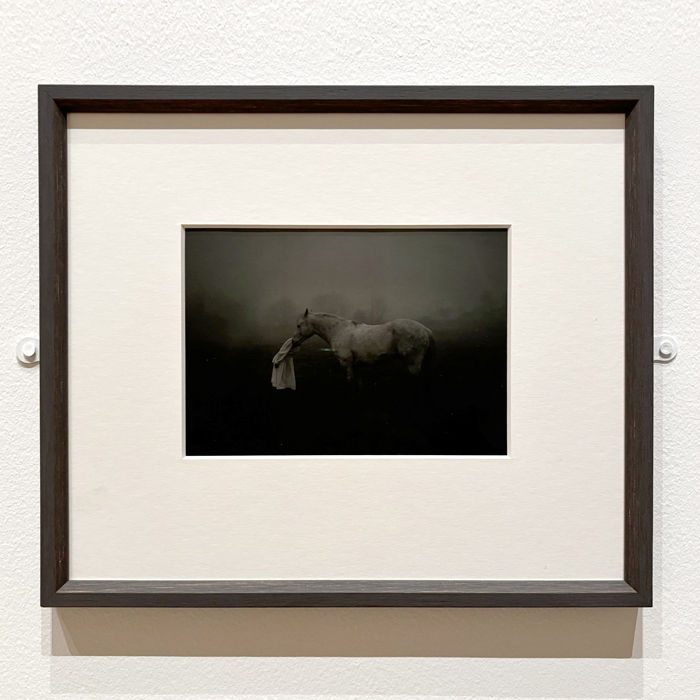
There were a huge number of entries and this is resulted in a broad range in work. For a selection procedure that could have been cumbersome to navigate, it is a good representation of the different types and high quality of work made in East Anglia.
The selection panel for In Proximity have encouraged artists based within the eastern counties to submit new or recent work that sums up their relationship with their surroundings and how their understanding of place, objects, people and other life forms emerge in their work. Selectors were Sarah Lowndes - Independent Curator, Daniel and Clara - Artists, Amanda Geitner - East Anglian Art Fund Director, based at the Castle Museum, and Lisa Newby - Curator of Modern and Contemporary Art, also at the Castle Museum.
Paul and I appreciated the trouble the panel went through in pulling this off. The remit for the show aligns closely with our own values and exhibition programme. In fact many of the artists we have worked with during the last nine years are significant contributors to the show, particularly the sculptors and artists working in 3D with unconventional materials and ceramics. Their being included in this survey exhibition is validation for these artists who have frequently found their work ignored by East Anglian museums and galleries, despite their work being displayed elsewhere in the country. It is encouraging to see evidence of the change of perception within 'the institution'.

Above Carolyn Brookes-Davies, who showed with us in the viewing room last October along side painter and printmaker Peter Wylie.
Foreground - steel bound Vessel and background - steel bound Razor Stack.
 Above 'Turn Off Your Mind' diptych painting on gesso panels by Claire Cansick,
Claire will be showing with us in May along side ceramic sculptor James Evans.
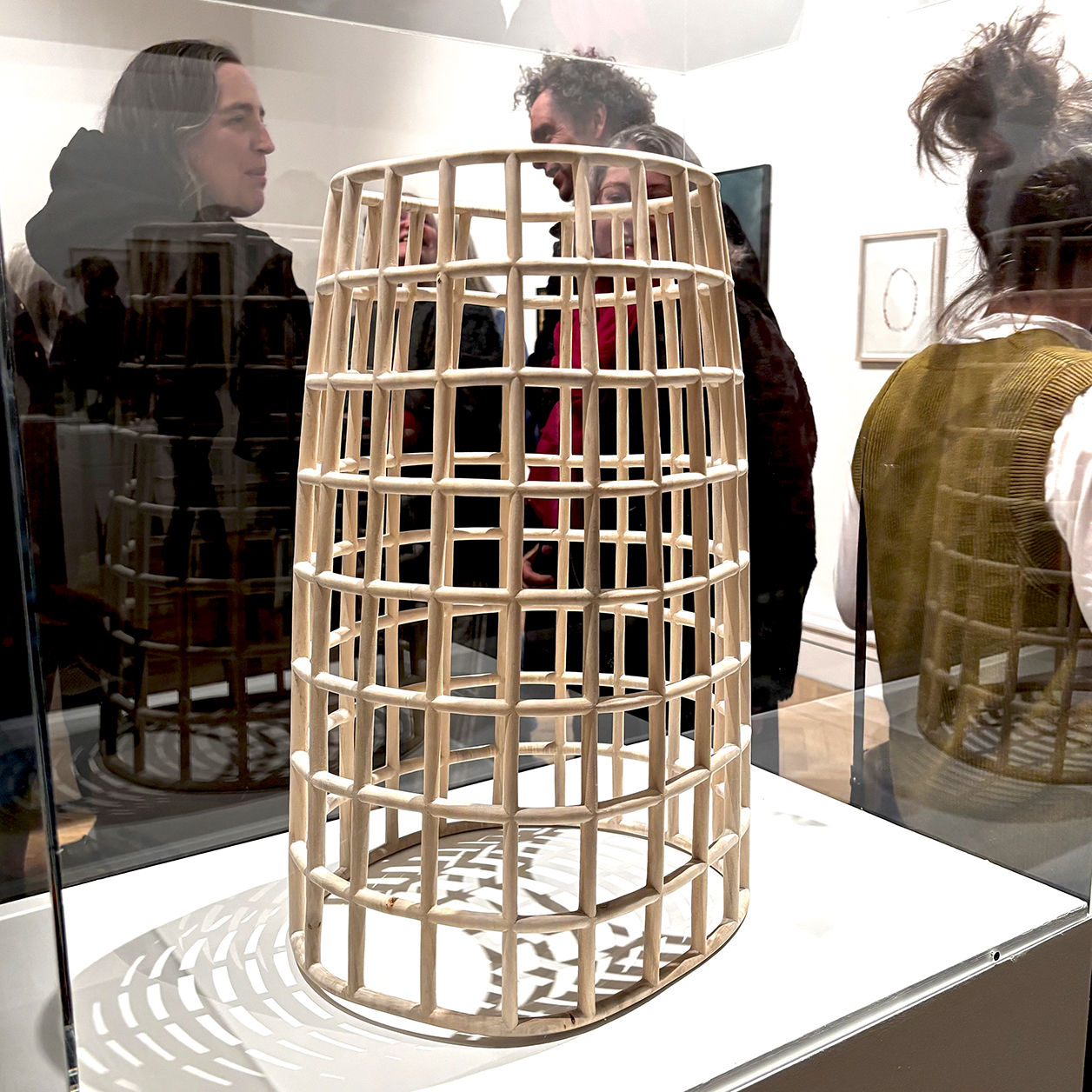
Above 'Trace' hand-carved, bleached lime wood sculpture by Jack Wheeler. Jack has shown with us at River's Edge, Ballroom Arts in Aldburgh and Lay of the Land two years ago in King's Lynn.

Above "Sister I, 2025" by Victoria Fenn, who will also be showing with us later this year
Some noteable works clockwise from top left: Rollo Timothy George "Fire Extinguisher, 2024"; Mathew Bennington "There Lie They and Here Lie We Under the Spreading Chestnut Tree, 2020"; Matthew Richardson "Settlement, 2025"; James Gladwell "Two Vases on Top of Each Other, 2025"
from left to right "By Arrangement, 2025"; Tessa Newcomb "Latch, 2025" Keron Beattie.
from left to right: "The Problem Horse and Other Stories #30, 2022"; Julie Sleaford; "In the Hanging Garden, 2025" and "We Bleed together, 2025" Nessie Stonebridge.
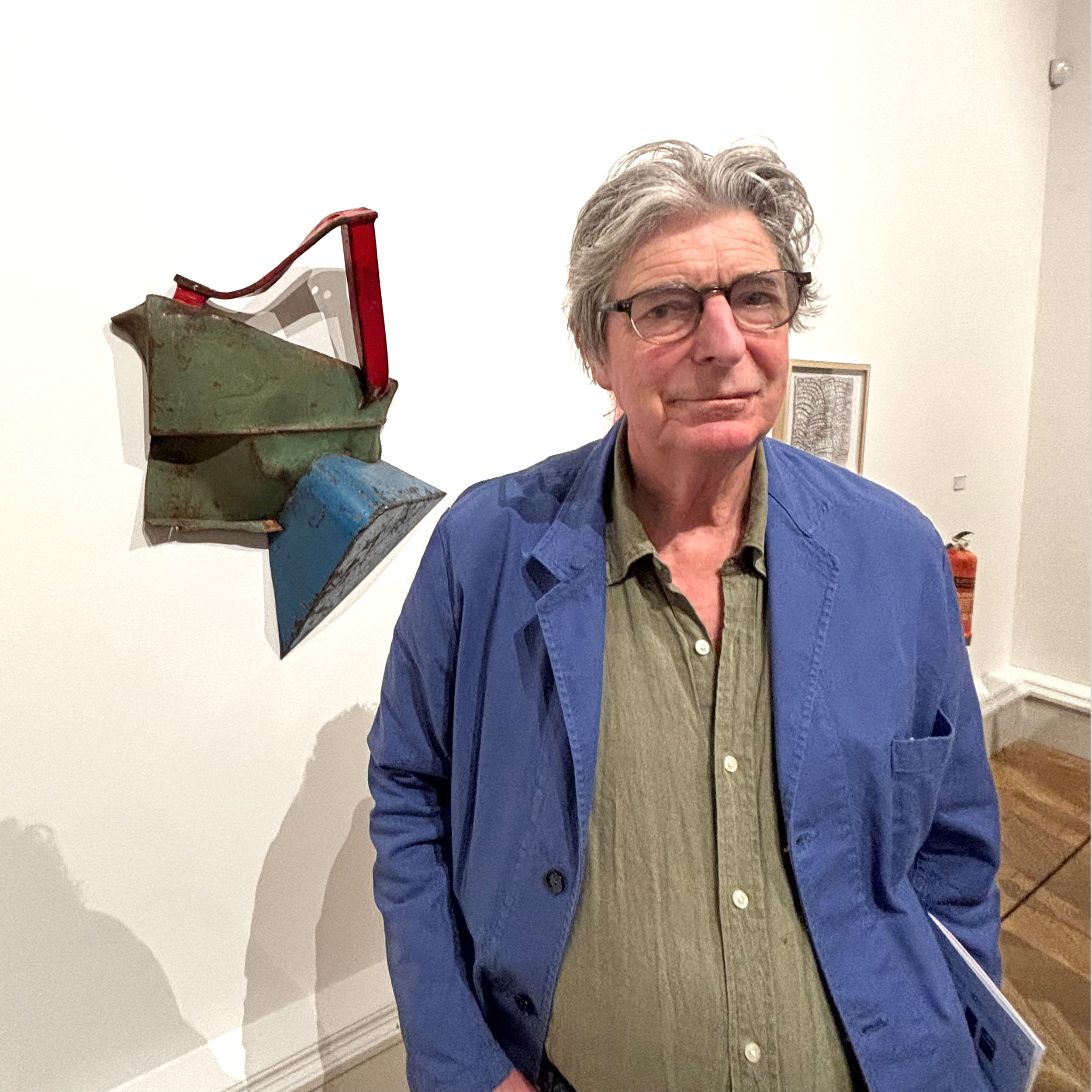
"Vécu, 2024"; Telfer Stokes
The selection panel has included work that is more representative of what is actually produced here, rather than pursuing the usual agenda. This may be down to the new eyes on the panel, which comprised of fresh new talent – curators, Sarah Lowndes and Lisa Newby, and the artist duo Daniel and Clara. The change is to be welcomed.
There is however, a minor caveat to do with the submission agreement. In Proximity is a fundraising exhibition with a proportion of the sale price of each artwork going to support the activities of the East Anglian Art Fund (EAAF). The selection panel have made it a condition for participating artists to donate a percentage of the proceeds of their work, if sold, to the EAAF. A worthy cause, although the model comes with two issues that in the long-term, will be an underlying problem.
A similar arrangement happens at the Royal Academy for a limited number of exhibitions and sales through the RA Editions series, where the artists are expected to support the workings of the academy as an institution. A number of Royal Academicians have made a lot of money producing their work, and they are only too pleased to be in the financial position to raise money for the academy. But the Castle Museum is not the RA. Many of the artists who would like to enter work into the exhibition are not in the same enviable financial situation as the academicians at the RA.
The purpose of an open call exhibition is to provide a kind of survey of visual art practitioners working at the moment within a given area. It acts as a kind of census of creative activity. Holding an exhibition like this should be something that happens every five-years or so, to check on the 'health' of artistic activity in the region. They are held by a public sector gallery or contemporary art space. It should be as inclusive as possible to encourage those with less stable earning power to participate or at least to submit work for consideration. It is an important component of a region's public service provision for the visual arts that it encompasses creative people from a wide variety of social backgrounds.
For this reason alone open call exhibitions are not conventionally an opportunity to raise money to subsidise a membership organisation made up of patrons of the arts. EAAF is a funding body and its patrons are crucial to its grant giving activities, attracting private sector money to support its public sector remit, not the other way around. Perhaps we have reached the stage where even the well-heeled are finding things tough enough to expect the artists themselves to part-fund the activities that should really be covered by the institution?
The EAAF receives public as well as private funding from its membership fees and donations, yet it is obviously not receiving what it needs to fully support exhibitions like this. Which is less than ideal.
Having said this, at least something is happening... The exhibition In Proximity is really worth seeing and is a fitting testament to the creative health of the East Anglian region, even if the public sector funding levels do not reflect what is actually a burgeoning scene for creative talent.
More information visit the Norwich Castle Museum website
About the author

Paul Barratt
Paul Barratt started working in contemporary art galleries in 1989, having graduated in Fine Art from Goldmsith’s, London University. He initially worked at Anthony d’Offay Gallery, one of the contemporary art dealers, who dominated the London art market in the 80s and 90s. He was approached by the Lisson Gallery to be gallery manager for the influential art dealer Nicholas Logsdail. This was followed by a short period in New York at Gladstone Gallery, to work for visionary art dealer Barbara Gladstone, working with the artist and filmmaker Matthew Barney.
On his return to London, Paul secured a place on the postgraduate curatorial course at the Royal College of Art, to complete an MA. After graduation in 2001, he worked as an independent curator on several projects in Oslo, London, Brighton and Basel, before joining Paul Vater at his design agency Sugarfree in 2004. He has worked with Paul ever since.